

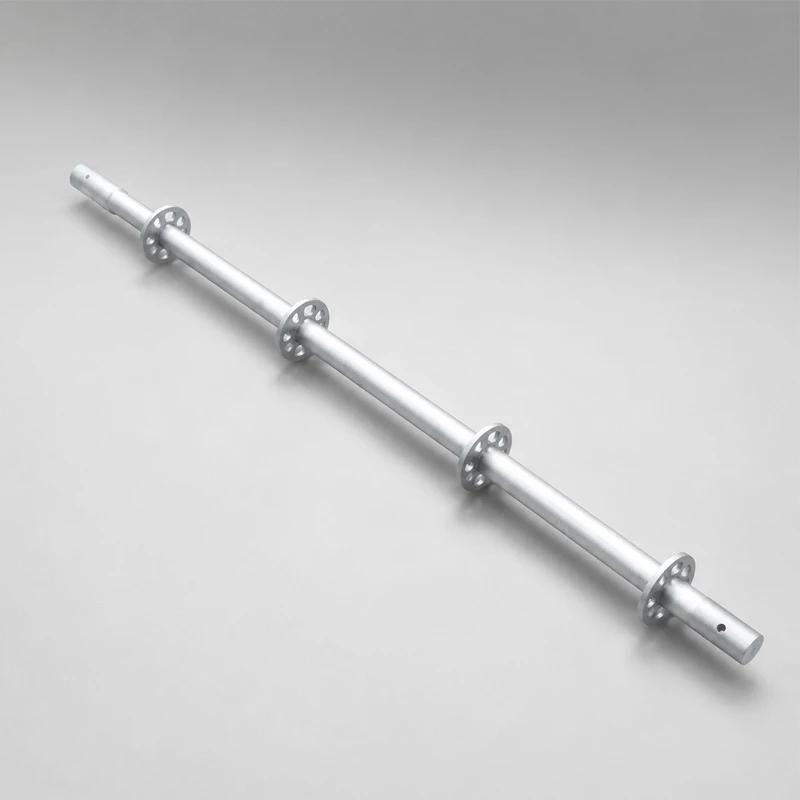
Hebei Shuangtai Mold Frame Technology Co., Ltd. is one of the most reliable manufacturers and suppliers of ringlock scaffold standard in China, featured by quality products and good service. Please rest assured to buy discount ringlock scaffold standard from our factory. We also accept customized orders.
The ringlock scaffold standard serves as the primary vertical load‑bearing component within the full ring‑lock scaffolding system, undertaking the core task of transferring upper‑layer construction loads down to the ground foundation. Its structural layout adopts an integrated welded design: multiple circular rosette discs are welded at fixed intervals along the vertical steel tube body. These rosettes reserve multi‑directional connection holes, which can fasten ledgers and diagonal braces via wedge pins, forming a stable triangular lattice force‑transfer framework together with horizontal and diagonal members. The bottom end of the standard is equipped with an inner connecting sleeve, while the top end retains an external inserting section. When erecting multi‑layer scaffolding, the inserting segment of the upper standard can be precisely nested into the inner sleeve of the lower standard, completing vertical butt joint and force transmission without extra auxiliary fasteners
In terms of material and specifications, this vertical pole applies low‑alloy steel Q355B as raw material, with a wall thickness of 3.25 mm. Multiple finished lengths are available for engineering selection, including 500 mm, 1000 mm, 1500 mm, 2000 mm, 2500 mm and other mainstream sizes to match different storey heights and formwork elevation demands. All finished standards go through hot‑dip galvanizing surface treatment. The zinc coating thickness reaches 70 μm or above, fully isolating the steel substrate from humid air, rainwater and construction‑site corrosive dust. Every welding procedure for rosette discs is finished by automatic special welding machines instead of manual welding. This processing mode effectively cuts down human‑caused defects, secures welding penetration and guarantees consistent mechanical performance of every welding joint
This vertical component brings distinct practical advantages for site operation. First of all, high interchangeability: every finished piece keeps tight dimensional tolerance after automated production. Components from different batches can be freely matched on‑site without modification or grinding, greatly lowering pre‑assembly preparation work. Secondly, excellent structural reliability. After wedge pins are hammered and self‑locked, the rosette‑and‑pin connection delivers anti‑pull capacity over 3 kN. Once assembled, the joint will not get loose under vibration caused by construction machinery or frequent personnel walking. Thirdly, long‑term anti‑corrosion performance. Compared with painted or spray‑painted scaffolding tubes, hot‑dip galvanized layers resist scratch and abrasion during transportation, stacking and erection. It can maintain stable performance in outdoor open‑air environments for years and cut overall project input on component replacement
It adapts to diversified complex application scenarios. For instance, in bridge pier formwork support projects, standards of 2.0 m and 2.5 m are combined for high‑formwork support systems to bear heavy concrete pouring loads. In tunnel interior renovation and support construction, short‑size standards of 0.5 m‑1.5 m are adopted to fit limited headroom inside tunnels. In high‑rise building formwork support, multi‑section standards are butt‑jointed vertically to build high‑altitude formwork support frames. Besides, it is also widely deployed for equipment installation in oilfield sites and temporary support frames in ship‑building workshops. When cooperating with base jacks, ledger bars and diagonal braces, it builds geometrically unchanged support systems to satisfy varied load requirements from light‑duty access scaffolding to heavy‑duty formwork supports
During on‑site application, users need to follow erection specifications. The lower standard is placed onto adjustable base jack, and the bottom end must fully sit on the stress groove of the adjusting nut. The upper standard inserting section should be pushed all the way into the lower connecting sleeve until reaching the bottom position, which can be checked through inspection holes reserved on sleeves. All matched wedge pins must be hammered to achieve self‑locking status to prevent falling off
Hot Tags: ringlock scaffold standard, China ringlock scaffold standard manufacturers, suppliers, Adjustable Ringlock Base Jack, Ledger for Ringlock Scaffolding, Ringlock Adjustable U Head Jack, Ringlock Diagonal Brace, Ringlock Scaffold Base Jack, Ringlock Vertical Standard


